


From Throne to Podium: Designing the King Charles iii Challenge Coin
- Admin
- Oct 7, 2025
- 6 min read

Updated: Nov 3, 2025

We’ve designed coins for presidents, prime ministers, and physicians. But when the words ‘King Charles III Coronation’ landed in our inbox, we stopped—not out of hesitation, but reverence. This wasn’t another project. This was history in motion. A new monarch. A new chapter. A moment the world had been holding its breath for
Coronations don’t happen often. And when they do, every detail matters—down to the palace gates. So we leaned in. Dug deep into the legacy of the British monarchy. Studied the symbolism of St. James’s Palace, where Charles’s reign officially began. Debated fonts with British restraint. Researched Jony Ive’s coronation emblem with design envy. And all of it led to one bold, regal, antique gold coin meant to hold centuries of tradition—and one very modern monarch—in the palm of your hand.
The Throne vs. The Podium
Here’s the thing nobody warns you about when you start designing for a monarch: you’re not sketching a portrait, you’re sketching an argument. An argument between past and present, ceremony and service, throne and podium. It’s the eternal tug-of-war: do you honor the image of Charles seated—still, solemn, framed by velvet and marble like a cathedral painting? Or do you honor Charles standing—microphone in front, sleeves rolled, stepping into the impossible immediacy of duty?
The throne whispers permanence. The podium shouts relevance. Which defines a king stepping into a new era? That’s the question circling our studio like a hawk. And yes, we’re yelling about it (kindly). Because this isn’t just illustration—this is narrative. Do you lock him into the continuity of tradition, or let him breathe as a man who has inherited a microphone, not just a crown? Both are true. Both matter. The tension is the story.
Legacy in Transition
Designing for Elizabeth meant endurance. She was the steady metronome of a nation—her portrait was less a likeness than a promise. With her, you could lean into symbols of stability, longevity, constancy. She held the monarchy like a mountain holds weather.
Charles? Charles is transition personified. His reign began not in celebration but in mourning. His first official act was stepping into his role at St. James’s Palace the very day after his mother’s death. He inherits a crown heavy with expectation—and an institution searching for relevance. So what do we etch? What do we elevate? How do you build a bridge of metal between endurance and expectation, between Elizabeth’s memory and Charles’s mandate? That’s the work that keeps us pacing like philosophers wired on cold brew—tired, maybe, but fully alive in the argument.
St. James’s Palace
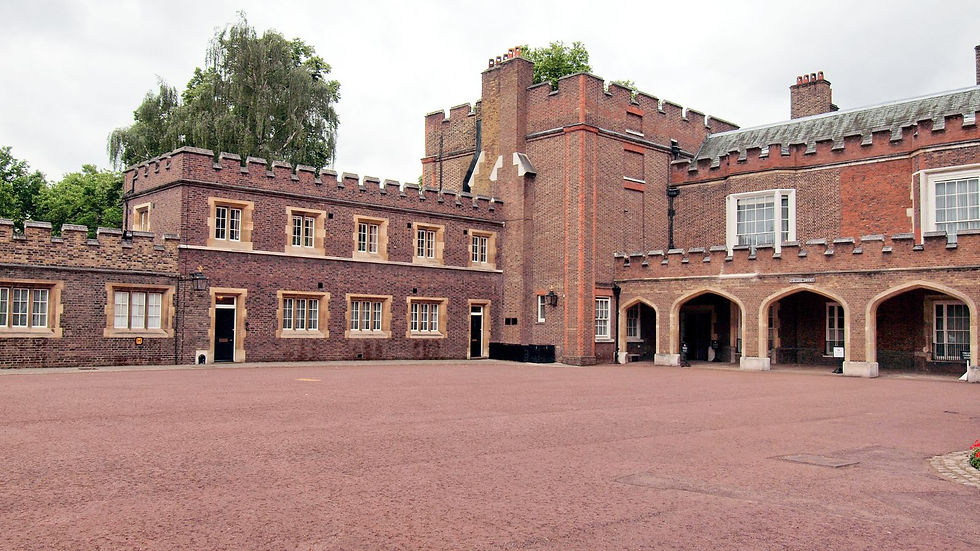
Let’s talk about the palace nobody Instagrams. Buckingham gets the postcards. Windsor gets the Netflix specials. But St. James’s Palace—the red-brick Tudor fortress tucked in London’s quieter streets—carries a weight all its own. It’s not flashy. It’s not sprawling. But it is where history puts down its pen and says: this is the page that matters.
On September 8, 2022, it was at St. James’s that Charles was formally proclaimed King. Think about that. Not in Westminster Abbey, not on a gilded balcony, but in a place built in 1531, quieter than its neighbors, more shadow than spotlight. Its façade, if etched in metal, doesn’t play the role of background. It becomes a witness. It says: history doesn’t always need fanfare—it sometimes happens in the echo of hallways that weren’t designed for tourists.
And for us as designers, that makes St. James’s fascinating. It’s a palace that reminds you legacy is made in overlooked corners. In a coin, it becomes not architecture but testimony.
Royal Blue as Continuity
Now—let’s talk color. That deep royal blue that circles the title isn’t just an aesthetic choice (though yes, it does look stunning against antique gold). In heraldry, blue—or azure—is the color of loyalty, truth, and faith. It’s continuity embodied.
For centuries, British orders of chivalry have leaned into this color. The Order of the Garter? Its sash is a piercing blue that announces honor without needing words. By wrapping Charles’s new title in blue, the message is subtle but strong: yes, the monarch has changed, but the monarchy itself remains steady. The hue is continuity incarnate, whispering to every citizen that while faces shift, the frame does not.
In modern times, that continuity is more than aesthetic—it’s psychological. In a world of political turmoil, royal blue is reassurance. It says the institution is still here, tethered to the same promises it made centuries ago. In our studio, when we argue about shades of enamel, this is what we’re really arguing about: how to bottle loyalty, truth, and faith in pigment.
The Coronation Emblem by Jony Ive
And then—there’s the emblem. Not clip art. Not filler. But the official coronation emblem, designed by none other than Sir Jony Ive (yes, that Jony Ive—the design brain behind the iPhone, the iMac, the very objects our sketches live on).
He took the oldest symbols of the United Kingdom—roses for England, thistles for Scotland, daffodils for Wales, shamrocks for Northern Ireland—and reimagined them as a single crown. Minimalist. Circular. Almost digital in its restraint. This emblem is old-world tradition stripped to its essence. It’s unity made modern.
Here’s what blows our minds: the emblem doesn’t scream royalty with lions and swords and Latin scrolls. Instead, it whispers. It shows that the monarchy doesn’t have to out-shout modernity; it can adapt, harmonize, translate. For Charles, whose reign is forever tied to the word “transition,” this emblem becomes more than a logo—it’s a philosophy.
And for us? For us, it’s design with gravitas. It’s proof that even the most ancient traditions can bend toward simplicity and still carry the weight of a crown.
Holding the Debate in Metal

So here we are—cups of coffee gone cold, notes scattered like battle plans, one designer swearing that blue enamel needs to lean darker, another insisting the palace detail must catch the light just so. But beneath the chaos, this is the heartbeat: we’re telling a story about tension. Throne versus podium. Continuity versus change. Elizabeth’s memory versus Charles’s expectation.
The question isn’t which matters most—it’s how you carry both. That’s the messy miracle of design. That’s the story unfolding on our screens and in our arguments. And that’s what will eventually take shape in metal.
A Modern Monarch in Motion
If St. James’s Palace roots him in history, and royal blue wraps him in continuity, then Charles’s public work pulls him forward into the now. This is a king who has been speaking about climate change since the 1970s, long before it was fashionable or politically safe. Back then, people rolled their eyes at “the environmental prince.” Today? Those speeches read like prophecy.
That’s the paradox we’re sketching around: Charles is both traditionalist and radical. He upholds coronation rituals that trace back a thousand years—but he’s also on the phone with world leaders at COP summits, urging them to rethink how nations measure prosperity. He’s a monarch who inherits palaces but spends his capital on conversations about sustainability, urban planning, and the survival of the planet itself.
For us, this isn’t just trivia—it’s design oxygen. Because when you etch a symbol of his reign, you’re not only honoring a coronation. You’re acknowledging the dual weight he carries: guardian of continuity and herald of change. And maybe that’s the most modern symbol of all—that the crown doesn’t just rest, it moves.
King Charles III Coronation Challenge Coin

Creating a King Charles coin was a chance to freeze that transition in time. The antique gold finish along with beautifully etched with intricate detailing along the outer border, felt instantly regal—rich, warm, and respectful. At the top center of the design, the official coronation emblem by Jony Ive announced the new era with quiet elegance. Below it, twin banners mark the coronation itself: “Coronation of His Majesty King Charles III” and “May 6th, 2023.” Together, they form a timestamp of historic weight.
A royal blue ring wraps around the center, echoing the depth of ceremony and title: “King of the United Kingdom & 14th Commonwealth Realms.” And in the heart of the coin? A high-definition etched portrait of King Charles on his throne, wearing the Coronation Crown. It’s as close as you’ll get to holding Westminster Abbey in your hand.

The reverse continues the story. A red and blue ring declares “The New Monarch” and “King Charles III,” while a gold banner below reads, “Ascension to the Crown, September 8th, 2022, St. James’s Palace.” On the left, a regal symbol anchors the design. And in the center: King Charles at a podium, backed by the etched façade of St. James’s Palace, signaling the start of his new royal duties.
We also had the privilege of working on the Queen Elizabeth II challenge coin—a project steeped in reverence and admiration. That design honored her lifelong service. This one? It marks what follows.
This King Charles coin wasn’t just about the crown. It was about the moment the world exhaled and looked toward a new era. From the royal blue ring to the gleaming etched image of King Charles III seated on the throne, every curve of this coin was designed with reverence—and a little awe. We knew this wasn’t just another royal seal. This was the weight of history, pressed into gold.
Yes, we’re still (lovingly) arguing about front versus back, throne versus podium. But that’s the point—it was never about choosing sides. It’s all one story. Legacy and leadership. Past and future. A monarchy stepping forward while anchored in its roots.
We’re honored to have captured that story—one stroke, one symbol, one sovereign moment at a time. Maxed out, dialed in, and exactly where we’re meant to be.
Capturing History One Challenge Coin At A Time.
Contact us today to start creating your own piece of history.


Comments